







Indoor Connectivity: Why reliable wireless coverage in buildings and tunnels is becoming essential
80 per cent of all mobile data traffic occurs indoors. Nevertheless, mobile coverage inside office complexes, shopping centres, airports and underground tunnels remains poor — or simply non-existent — in many facilities to this day. This is not merely a matter of convenience. It is a security and compliance risk.
Radio Frequency Systems (RFS), one of the world’s leading manufacturers of RF infrastructure components, addresses precisely this challenge with a comprehensive portfolio of indoor connectivity solutions — from coaxial cable to radiating lines, and from passive components to fibre-optic solutions.
Why indoor radio communication is so difficult
A mobile phone mast covers an area of several kilometres. What it cannot do reliably is penetrate thick concrete walls, steel structures or underground spaces. The more modern and solid a building is, the larger the dead spot inside it.
Added to this is a regulatory reality: in many EU countries, operators of critical infrastructure are obliged to ensure mission-critical communications — for example, for the fire service, police and emergency services — even within buildings. Those who fail to comply risk not only fines, but also endangering human lives in an emergency.
The solution is what is known as a Distributed Antenna System, or DAS for short — a network of cables, antennas and passive components that actively distributes the radio signal to every corner of a building or tunnel.
Three technology families — one comprehensive solution
RFS offers indoor connectivity based on three core technologies, which can be used individually or in combination, depending on requirements:
RF (coaxial cable) forms the backbone of most DAS installations. RFS’s‘ CELLFLEX product range includes over 20 different cable types ranging from 1/4″ to 1-5/8″ — all with the lowest possible attenuation, full RFI/EMI shielding and minimal intermodulation. Particularly relevant for indoor applications: the flame-retardant JFN versions with CPR classifications up to B2ca, the highest achievable fire safety rating according to EU standard EN 50575.
Radiating cables (RADIAFLEX) are the most technically sophisticated components in an indoor DAS. Unlike conventional antennas, which transmit from specific points, radiating lines function as a continuous antenna along their entire length — ideal for tunnels, long corridors or complex geometries. RFS’s RADIAFLEX portfolio supports frequencies up to 7.2 GHz and is 5G-ready. The latest generation supports MIMO configurations — i.e. multiple parallel data streams — which enables download speeds of over 560 Mbit/s in railway tunnels, as demonstrated by the Follo Line project in Norway.
Fibre-optic and hybrid (HYBRIFLEX)) complements the RF system wherever long distances, high capacities or the deployment of remote unit structures are required. HYBRIFLEX combines fibre-optic and RF components in a single cable — this significantly reduces installation effort and makes the system easier to maintain.
Every sector has its own challenges
What sets RFS apart from a mere component supplier is its industry-specific understanding of systems. This is because the requirements for indoor connectivity vary fundamentally depending on the area of application:
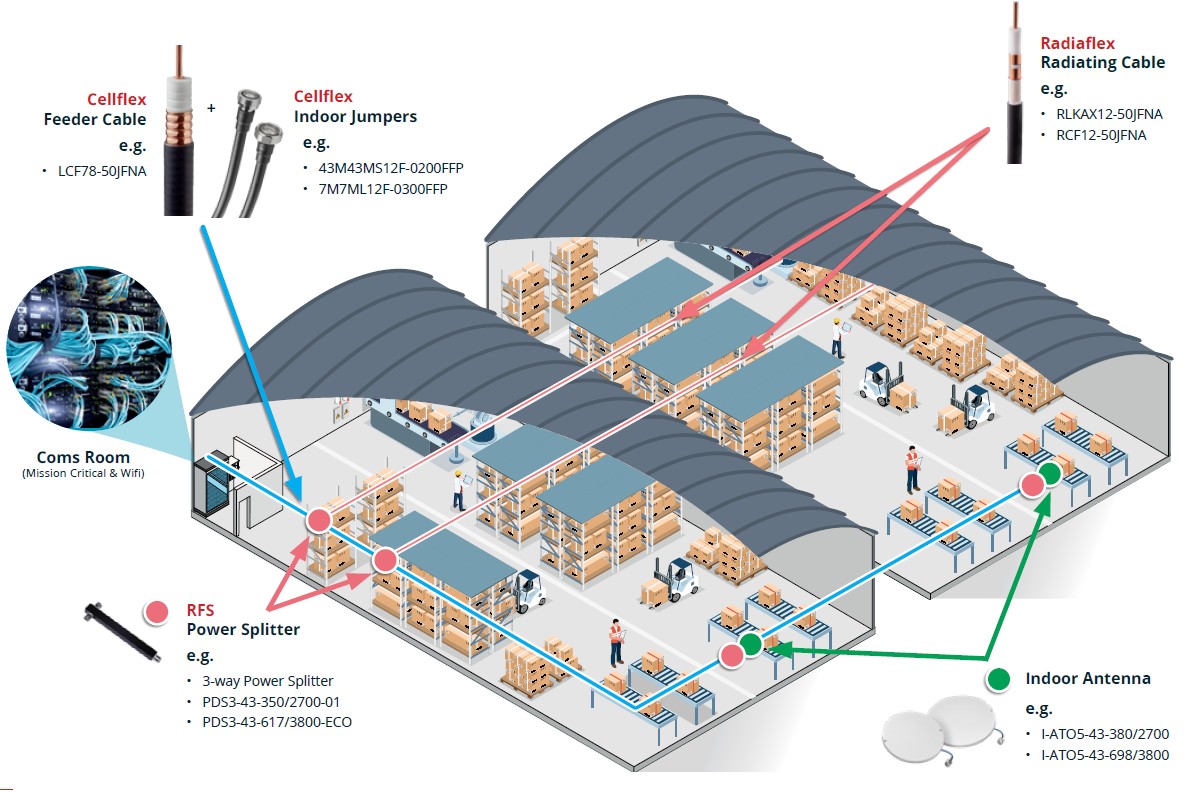
Warehouses and industrial facilities are characterised by metal shelving, steel beams and changing layouts — all classic „signal killers“. Here, RFS combines radiating cables for the storage areas with DAS systems for loading bays and office areas.
Airports They have to provide commercial mobile communications to thousands of passengers at the same time, whilst also supplying security authorities with mission-critical communications — often across different frequency bands and technologies. RFS relies on technology-agnostic solutions that cover all bands up to 6 GHz.
Stadiums present particular challenges: tens of thousands of users in a very confined space, alongside security teams and emergency services. The solution requires highly precise radiation patterns, MIMO-capable stadium antennas and a robust backbone infrastructure.
Railway tunnel are the most challenging environments of all. Cramped conditions, poor ventilation, high mechanical stresses and the loss of radio signals caused by fully occupied trains — all of this calls for precise RF engineering. RFS RADIAFLEX According to the manufacturer, it is installed in around 50 per cent of all underground systems worldwide, including those in London, Paris, Hong Kong, Sydney and Wuhan.
Fire safety is not an option
Since July 2017, the following has applied in the EU: all communication cables installed in buildings must comply with the Construction Products Regulation (CPR) and be classified in accordance with EN 50575. RFS was the first cable manufacturer to offer RF communication cables with the highest CPR class, B2ca — and has been operating its own fire test chamber in Hanover, certified to EN 50399, since 2024.
In practical terms, this means for planners and operators that anyone who RFS cable When installed, it automatically complies with the strictest European fire safety regulations — including the d0 classification, meaning no burning particles.
Indoor connectivity is infrastructure, not an option
Whether it’s a logistics centre, a hospital, an airport or a railway tunnel — reliable radio coverage is now a fundamental requirement for safe operations and regulatory compliance. RFS is one of the few manufacturers to offer a complete end-to-end solution from a single source, with over 40 years’ experience and a proven track record across all continents.
E.Hartner is an authorised RFS partner for Austria and the DACH region. We are happy to assist with project enquiries and provide technical advice.